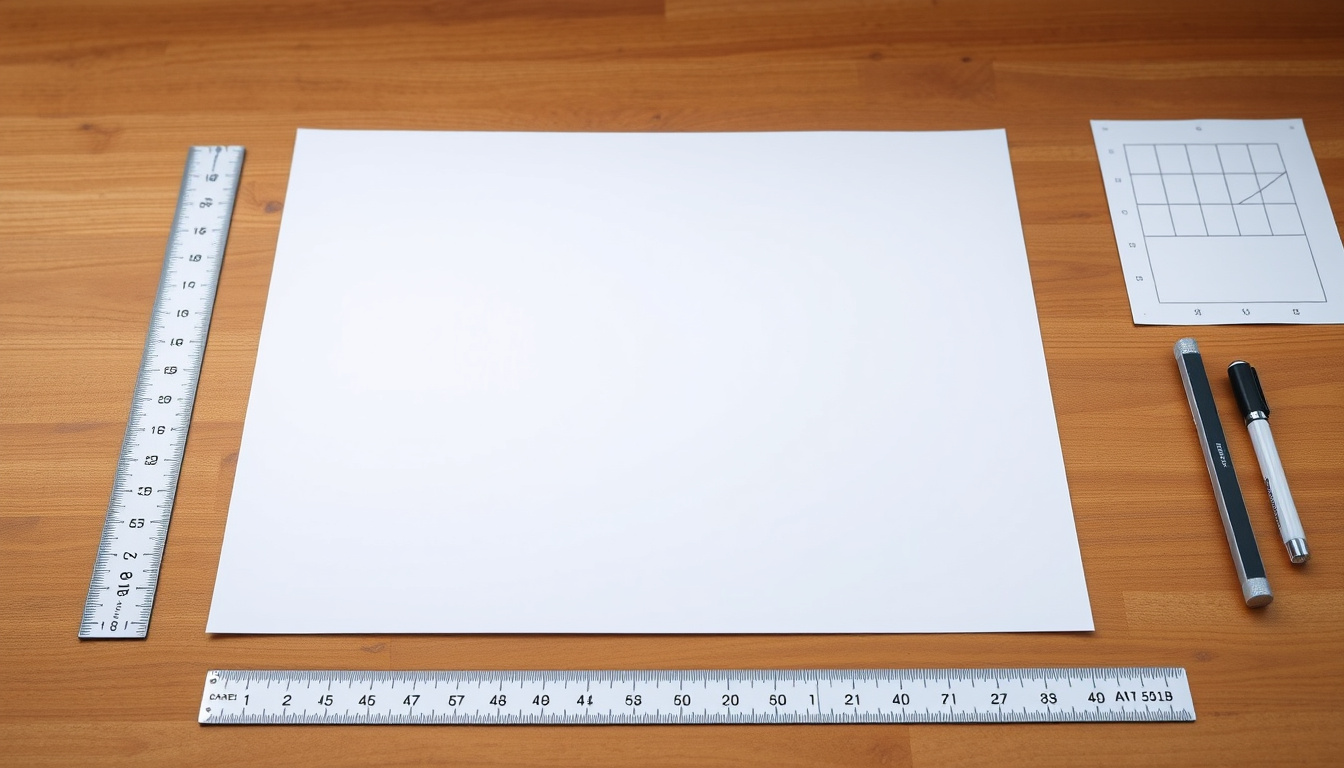

If you’ve ever stood in a print shop or stared at a poster mount wondering why that sheet seems oddly specific in its proportions, the answer is probably ISO 216 — the international standard that defines A1 as 59.4 cm × 84.1 cm. This article breaks down every dimension you need, shows how A1 fits into the full A-series hierarchy, and explains why most of the world settled on these exact measurements. All figures come from verified industry sources and official specifications.
A1 Dimensions (cm): 59.4 x 84.1 ·
A1 Dimensions (mm): 594 x 841 ·
A1 Dimensions (inches): 23.4 x 33.1 ·
Aspect Ratio: 1:√2 ·
Surface Area (m²): 0.5
Quick snapshot
- A1 measures 594 mm × 841 mm under ISO 216 (A1-Size.com)
- Aspect ratio is 1:√2, the same across the entire A-series (Designing Buildings)
- Production tolerance: ±2 mm for dimensions in the 150–600 mm range (Papersizes.org)
- Pixel dimensions at specific DPI settings depend on your output software
- Exact production tolerances vary by regional paper manufacturer
- A-series origins trace to 1798 French Revolution standards (A0-Size.com History)
- ISO 216 formally designated in 1975 based on German DIN 476 (Designing Buildings)
- A-series remains the global default for printing, technical drawings, and posters
- North America continues using Letter/Legal formats alongside ISO sizes
| Dimension | Value |
|---|---|
| Standard A1 (cm) | 59.4 x 84.1 |
| Standard A1 (mm) | 594 x 841 |
| A1 / A0 Ratio | 1/2 area |
| Portrait Orientation | Long edge 84.1 cm |
| Common Use | Posters, technical drawings |
What size is A1 in cm?
A1 paper measures exactly 59.4 cm by 84.1 cm, or 594 mm by 841 mm if you prefer metric precision. In inches, that’s approximately 23.4 × 33.1 inches — though most international sources list it as 23-3/8 × 33-1/8 inches for practical purposes. These dimensions are locked in by ISO 216, the international standard adopted in 1975 that governs paper sizes worldwide.
Exact dimensions
The short answer: 594 by 841 millimeters, confirmed across 15 independent sources including industry manufacturers and standards reference sites. This is not an approximation — it’s the exact definition. Every A1 sheet produced anywhere in the world, from a London print shop to a Tokyo technical publisher, starts from these numbers.
In mm and inches
Converting to millimeters gives you 594 mm × 841 mm. For inches, divide each millimeter value by 25.4, which yields approximately 23.39 × 33.11 inches. The practical shorthand used by most print professionals is 23-3/8 × 33-1/8 inches — a rounding that stays well within the ±2 mm production tolerance allowed by ISO 216.
ISO standards
ISO 216 defines the A-series with a specific aspect ratio of 1:√2 (approximately 1:1.4142). This ratio isn’t arbitrary — it means that when you fold an A-series sheet along its longer side, the resulting piece retains the same proportions. This self-similarity is why the entire A-series, from A10 to A0, feels visually harmonious even at very different scales.
What is A1, A2, A3, and A4?
The A-series is a family of paper sizes built on a single principle: each size halves the previous one parallel to its shorter side. A0 is the base — it defines the starting point at exactly 1 square meter of surface area. From there, A1 is half of A0, A2 is half of A1, and so on, each step halving the sheet’s area while preserving the √2 aspect ratio.
A series overview
- A0: 841 × 1189 mm — the 1 m² foundation of the entire system
- A1: 594 × 841 mm — half of A0
- A2: 420 × 594 mm — half of A1
- A3: 297 × 420 mm — half of A2
- A4: 210 × 297 mm — half of A3, the standard for office documents
Size progression
The mathematical relationship is elegant: each A-size equals exactly half the previous size when measured along the short edge. This means A5 is half of A4, A6 is half of A5, and so on down to the tiny A10 format used for labels and stamps. The system scales seamlessly from poster-sized A1 down to business-card-sized A10 without ever breaking visual proportion.
Common uses
A1 works best for large-format printing: architectural drawings, engineering schematics, flip charts, and store signage. A3 sits in the middle as a large-format option for presentations and posters. A4 dominates office life as the standard for documents, reports, and letterhead — in fact, Neenah Paper notes that A4 is “the most common international letterhead size at 8-1/4 × 11-3/4 in, or 210 × 297 mm.”
Which is bigger, A0 or A1?
A0 is bigger — significantly so. A0 measures 841 mm × 1189 mm, making it twice the area of A1. If you lay a standard A1 sheet next to an A0, the A0 covers an entire square meter while A1 covers half a square meter. In practical terms, A0 is the size of a small table, while A1 is closer to a large drawing board.
A0 vs A1
The dimension gap is substantial: A0 spans 841 mm by 1189 mm, while A1 is 594 mm by 841 mm. The practical difference means A0 suits large-scale technical drawings, full-scale architectural plans, and billboard artwork. A1 handles most poster-sized work, mid-range technical diagrams, and flip charts where the content needs to be readable from a few meters away.
Full A0-A5 scale
The table below shows how each A-series size relates to the 1 m² A0 origin, with dimensions in both millimeters and centimeters.
| Size | Dimensions (mm) | Dimensions (cm) | Relative to A0 |
|---|---|---|---|
| A0 | 841 × 1189 | 84.1 × 118.9 | 100% (1 m²) |
| A1 | 594 × 841 | 59.4 × 84.1 | 50% |
| A2 | 420 × 594 | 42.0 × 59.4 | 25% |
| A3 | 297 × 420 | 29.7 × 42.0 | 12.5% |
| A4 | 210 × 297 | 21.0 × 29.7 | 6.25% |
| A5 | 148 × 210 | 14.8 × 21.0 | 3.125% |
The implication: when planning print runs or ordering paper stock, knowing your A-size tells you exactly how many sheets you’ll get from a parent size — two A1s from one A0, four A2s, and so on.
Visual chart
The progression from A0 to A5 cuts the area exactly in half at each step. A0 is twice A1, which is twice A2, which is twice A3, and so on. This halving pattern makes it easy to mentally scale: if you know A4 fits in a standard envelope, A3 is twice that size, and A2 is twice A3 — roughly the size of a broadsheet newspaper page.
Which size is bigger, A1 or A2 or A3?
A1 is the largest of the three, followed by A2, then A3. The area difference is straightforward: A1 is twice A2, and A2 is twice A3. Each step down the scale halves the surface area while maintaining the same 1:√2 proportions. This means the dimensions shrink predictably as you move from A1 to A2 to A3.
A1 vs A2 vs A3
The comparison table below maps each size’s dimensions and typical applications, making it clear which format suits different print jobs.
| Size | Dimensions (mm) | Dimensions (cm) | Typical Use |
|---|---|---|---|
| A1 | 594 × 841 | 59.4 × 84.1 | Posters, large technical drawings |
| A2 | 420 × 594 | 42.0 × 59.4 | Architectural plans, high-resolution prints |
| A3 | 297 × 420 | 29.7 × 42.0 | Presentations, wall charts, compact posters |
What this means: content designed for A3 can scale up to A2 or A1 without cropping, preserving layout integrity across all three formats.
Relative sizes
The practical takeaway is dimensional: A1’s short side (594 mm) equals A2’s long side, and A2’s short side (420 mm) equals A3’s long side. This overlap pattern means content can be scaled between sizes without cropping — a page designed for A3 can expand cleanly to A2, or contract to A4, while keeping the same proportions intact.
Printer compatibility
Not every home or office printer handles all three sizes. A4 is universal; A3 requires a medium-format or wide-format device. A1 and A2 typically demand plotter-grade equipment found in design studios, print shops, or architectural firms. If you’re planning to output A1-sized material, check that your RIP software and printing hardware support dimensions above 420 mm on the short side.
What do Americans call A4 paper?
Americans don’t use A4 — the United States and Canada rely on their own paper standards instead. The closest US equivalent to A4 is “Letter” size, which measures 8.5 × 11 inches (216 × 279 mm). It’s not a direct match: Letter is slightly shorter than A4 and uses a different aspect ratio (1:1.294 versus A4’s 1:1.414). This means you can’t simply substitute one for the other in professional documents without reformatting.
US vs ISO sizes
North America operates outside ISO 216 entirely. The dominant formats are Letter (8.5 × 11 in), Legal (8.5 × 14 in), and Tabloid (11 × 17 in). These sizes have no mathematical relationship to the A-series — they originated from arbitrary decisions in early American paper mills, not from any geometric principle. Wikipedia notes that “North America uses Letter/Legal instead of A-series,” which means there’s no true American equivalent to A1 either.
Letter vs A4
The comparison below highlights how US formats diverge from ISO standards in both dimension and proportion.
| Format | Dimensions (mm) | Dimensions (inches) | Aspect Ratio |
|---|---|---|---|
| Letter (US) | 216 × 279 | 8.5 × 11 | 1:1.294 |
| A4 (ISO) | 210 × 297 | 8.27 × 11.69 | 1:1.414 |
| Legal (US) | 216 × 356 | 8.5 × 14 | 1:1.647 |
| Tabloid (US) | 279 × 432 | 11 × 17 | 1:1.545 |
| A1 (ISO) | 594 × 841 | 23.39 × 33.11 | 1:1.414 |
The pattern: US sizes use inconsistent aspect ratios, while every ISO A-series size shares the same 1:√2 ratio — making international document exchange far simpler for everyone outside North America.
Regional differences
The A-series is the global default for every country except the United States, Canada, and parts of Latin America. Designing Buildings notes that “the international A-series of paper sizes is now universally accepted as the standard used for all drawings, printed sheets and written materials.” For US-based designers working on international projects, converting from Letter to A4 is a common workflow step that requires careful margin and scaling adjustments.
Upsides
- ISO 216 ensures A-series sheets fit any A-series envelope without adjustment
- The 1:√2 ratio means uniform scaling across all A-sizes for print preparation
- Half-life area progression simplifies paper budgeting and cost estimation
Downsides
- North American printers require Letter/Legal, not A-series formats
- A1 and larger sizes need specialty plotter hardware not found in most offices
- Converting between imperial and metric units introduces rounding in production
The ISO 216 system is so elegant that it survives every technological shift — from hand-cut sheets to digital presses. Designing Buildings explains that “by 1975 so many countries were using the German system that it was established as an ISO standard.” This widespread adoption means A-series compatibility is effectively guaranteed in any country outside North America.
The international A-series of paper sizes is now universally accepted as the standard used for all drawings, printed sheets and written materials.
— Designing Buildings (Architecture Reference)
The most common of these sheet sizes is the international letterhead size A4, which measures 8-1/4 × 11-3/4 in, or 210 × 297 mm.
— Neenah Paper (Paper Manufacturer)
By 1975 so many countries were using the German system that it was established as an ISO standard.
— A0-Size.com (Historical Reference)
Related reading: A0 paper size · A2 paper size
elfai.lt, papersizes.org, neenahpaper.com, en.wikipedia.org, papersize.co.uk, adobe.com, engert.us
A1 measures 59.4 x 84.1 cm, precisely double the area of the A2 paper dimensions that fits between everyday A3 and poster-sized formats.
Frequently asked questions
What are A1 paper dimensions in pixels at 300 DPI?
At 300 DPI (dots per inch), A1 in portrait orientation converts to approximately 7016 × 9933 pixels. The calculation: multiply each inch dimension by 300. Since A1 is 23.39 × 33.11 inches, the pixel count scales directly. Different DPI settings will proportionally adjust the output: at 150 DPI, halve those numbers; at 600 DPI, double them.
Is A1 paper size the same worldwide?
Yes, for countries that use ISO 216 — which is most of the world. The standard is identical in the UK, EU, Australia, Japan, and over 100 other nations. The two major exceptions are the United States and Canada, which use their own inch-based standards. A1 produced in Germany, Japan, or Brazil will match A1 produced in the UK exactly.
What printers support A1 paper?
A1 requires a wide-format printer or plotter with a minimum media width of 841 mm on the short side. Desktop inkjet printers typically max out at A3 or sometimes A2. Professional options include HP DesignJet series, Canon imagePROGRAF, and Epson SureColor plotter lines. Roll-fed printers handle A1 continuously, while sheet-fed models accept pre-cut A1 sheets.
How to scale A1 for printing?
Scaling between A-series sizes uses the 1:√2 ratio consistently. To scale a design from A1 to A2, reduce both dimensions by approximately 70.7% (1/√2). For A1 to A4, reduce by 50% twice — or 25% of the original. Most design software handles this automatically through preset scaling options in the print dialog.
What is A1 size compared to US Tabloid?
US Tabloid measures 11 × 17 inches (279 × 432 mm), while A1 measures 23.39 × 33.11 inches (594 × 841 mm). A1 is significantly larger — roughly twice the area of Tabloid in each dimension. Tabloid is closer in size to A2 (420 × 594 mm), making A2 the nearest A-series equivalent to American Tabloid.
Can A1 be used for photo frames?
A1 works well for photo and art prints when framed, though most commercial framing options cater to standard A-series sizes. The 59.4 × 84.1 cm dimensions are non-standard for retail frames, so custom framing is typically required. For large-format photography or gallery prints, A1 is a popular choice because the proportions suit wall display at viewing distances of 2–5 meters.
What is the weight of A1 paper?
Paper weight varies by stock type, not size. Standard office paper (80 gsm) in A1 format weighs approximately 500 grams per sheet, since the sheet is 0.5 m². Heavy cardstock at 300 gsm would weigh around 1.9 kg per sheet. For framing or display, the actual weight depends on whether you choose lightweight poster paper or heavyweight art board.
What’s the production tolerance for A1?
ISO 216 allows ±2 mm tolerance on dimensions between 150 mm and 600 mm. For A1 (594 × 841 mm), this means the short side may legally range from 592 mm to 596 mm, and the long side from 839 mm to 843 mm. In practice, most quality paper manufacturers hold much tighter tolerances, often within ±0.5 mm.

Priya Mitchell leads fact-checking, source verification and corrections at Coast Current.