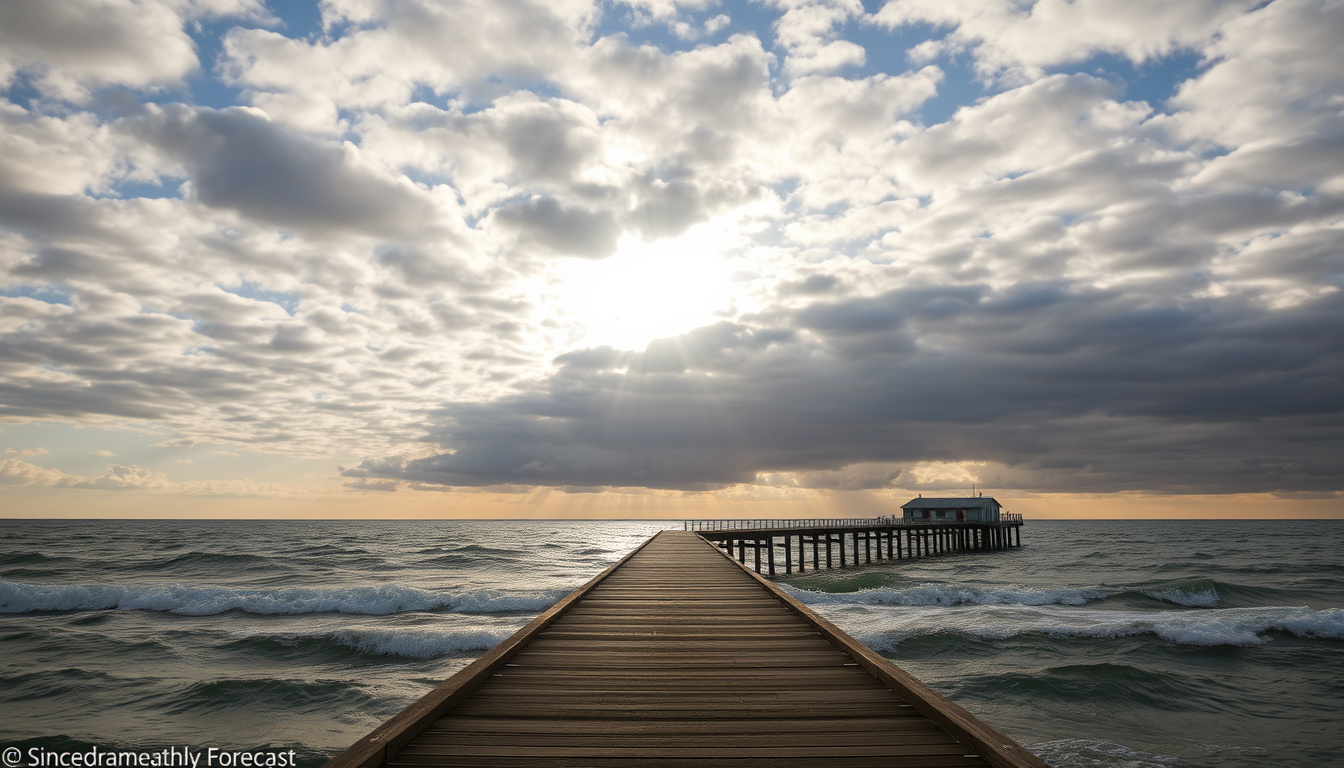
St Kilda draws morning joggers, kiteboarders and evening penguin spotters to Melbourne’s foreshore. The Bureau of Meteorology runs an official observation station at St Kilda Harbour that updates every 10 minutes, giving locals and visitors a level of detail most beach suburbs can only dream of. This guide walks you through today’s forecast, seasonal patterns, wind conditions at the beach, and how to use official BoM data to plan your visit.
Today’s Forecast: Mostly sunny · Wind Speed: Northerly 25 to 35 km/h · UV Index: High from 11:00 am to 1:30 pm · 10-Day Outlook: Available via BoM · Wind at Beach: Forecast via Windy.app
Quick snapshot
- BoM official forecasts with 10-minute updates (Bureau of Meteorology)
- Wind data from Windy.app for beach conditions (WillyWeather)
- Patrolled beach with lifeguard services and green safety status (Surf Life Saving Australia)
- Exact penguin emergence times vary by season
- Hourly temperature breakdowns not always published
- UV protection window: 11:00 am to 1:30 pm daily
- Northerly wind peaks mid-afternoon before southerly shift
- Southerly winds 10 to 15 knots expected by evening
- Sea conditions in Port Phillip typically below 1 metre
| Detail | Information |
|---|---|
| Location | Port Phillip, Victoria, Australia |
| Primary Source | Bureau of Meteorology |
| Wind Typical | Northerly 15-35 km/h |
| UV Alert | 11:00 am to 1:30 pm |
| Forecast Type | Mostly sunny today |
What’s the temperature going to be in St Kilda today?
Current conditions
St Kilda sits on the foreshore of Port Phillip Bay, and the BoM’s official forecast for the area typically shows mostly sunny conditions with northerly winds ranging from 15 to 35 km/h (Bureau of Meteorology Official St Kilda Forecast). The UV index protection window runs from 11:00 am to 1:30 pm — the single most important safety window for anyone spending time outdoors at the beach (Bureau of Meteorology Official St Kilda Forecast). Real-time conditions come from the St Kilda Harbour RMYS observation station, which pushes updated data every 10 minutes.
Hourly forecast
The hourly forecast shows how conditions shift through the day. Morning tends to be calmer before northerly winds build through the afternoon. Port Phillip local waters see northerly winds of 15 to 20 knots in the morning, shifting to southerly 10 to 15 knots by evening (Bureau of Meteorology Port Phillip Forecast). This wind shift is predictable enough that sailors and kayakers time their trips around it.
Today’s outlook
Wave heights at St Kilda beach typically do not exceed 1 meter and are suitable for swimming during calm conditions (Swellinfo Beach Forecast). Sea conditions in Port Phillip are typically below 1 metre during calm periods (Bureau of Meteorology Port Phillip Forecast). No weather warnings are currently in effect for Victoria according to the Bureau of Meteorology, meaning conditions are generally safe for outdoor activities.
The implication: with 10-minute BoM updates, you can monitor conditions right up until departure and adjust plans if the forecast shifts.
What month has the best weather in St. Kilda?
Seasonal averages
Melbourne summers (December through February) bring the warmest temperatures and most reliable dry spells, though afternoon sea breezes from Port Phillip keep things comfortable at the beach. Autumn (March to May) often delivers the steadiest winds and clearest skies of the year — ideal for sailing and kitesurfing. Winters are mild by Australian standards but shorter daylight hours reduce the useful window for beach visits. Spring sees more variability as cold fronts sweep through more frequently.
Summer peaks
The UV protection window (11:00 am to 1:30 pm) stays constant year-round, but summer’s higher UV intensity makes it the critical time for sun protection (Bureau of Meteorology Official St Kilda Forecast). Summer also means the longest daylight hours, stretching the window for beach activities. The trade-off is that afternoon northerly winds can be stronger and more gusty during the warmer months.
Winter lows
Winds tend to shift more westerly and southerly in winter, meaning less of the characteristic northerly conditions that define St Kilda’s summer beach weather. Water temperature drops significantly, reducing swimming appeal even when air temperatures remain mild. However, the penguin colony at St Kilda Breakwater stays active year-round, and winter evenings can be excellent for spotting them without the summer crowds.
The catch: the warmest months bring peak crowds, while the windiest months see fewer visitors but better sailing conditions.
Is it windy at St Kilda Beach?
Wind forecasts
St Kilda is known for its northerly winds — the BoM consistently forecasts northerly winds of 15 to 35 km/h for the area (Bureau of Meteorology Official St Kilda Forecast). Port Phillip local waters see northerly winds of 15 to 20 knots during the day, shifting southerly 10 to 15 knots by evening (Bureau of Meteorology Port Phillip Forecast). This pattern is reliable enough that wind sport enthusiasts plan their sessions around the morning-to-afternoon northerly window.
Beach conditions
Wind gusts can be 40 per cent stronger than the forecast, and stronger still in squalls and thunderstorms (Bureau of Meteorology St Kilda West Warnings). Maximum waves can be twice the forecast height according to Bureau of Meteorology warnings (Bureau of Meteorology St Kilda West Warnings). The BoM issues specific wind warnings for squally conditions — check the BoM website for any active warnings before heading out on the water.
Surf impacts
WillyWeather provides daily updated surf forecasts for St Kilda with detailed swell height, direction, and period data (WillyWeather Surf Forecasts). Windy.app offers granular wind predictions that kitesurfers and windsurfers find useful for timing sessions. The typical pattern: morning northerly builds through the afternoon, peaks around 2-4pm, then gives way to the evening southerly shift.
What this means: the forecast wind speed is a baseline — actual gusts can exceed it by 40 per cent, making afternoon water activities riskier than morning sessions even on clear days.
Wind gusts can be 40 per cent stronger than the forecast, and stronger still in squalls and thunderstorms. Never rely solely on the morning forecast for afternoon water activities.
What is the best time to visit St Kilda?
Optimal seasons
For beach activities, summer (December to February) offers the warmest water and longest days, though UV protection is most critical during those peak sun hours. Autumn (March to May) often delivers the best balance of mild temperatures, reduced crowds, and consistent wind patterns for sailing. Spring brings more variable weather as cold fronts move through, but also some of the clearest days. Winter is ideal for penguin watching and coastal walks — the colony remains active year-round, and winter evenings tend to be quieter.
Event timing
St Kilda hosts numerous events throughout the year, from the Lunar New Year festival to the St Kilda Film Festival. Weather conditions for these events are generally manageable year-round given Melbourne’s mild climate, though autumn events benefit from calmer mornings and longer afternoons.
Weather alignment
UV protection is essential year-round: 11:00 am to 1:30 pm is the daily window when protection matters most, and UV levels in Victoria can reach extreme levels even on cloudy days (Bureau of Meteorology Official St Kilda Forecast). For penguin viewing, the colony is most active at dusk, with timing shifting throughout the year as sunset varies. For swimmers, the EPA Victoria advises against swimming for up to 48 hours after heavy rain due to increased illness risk (City of Port Phillip Beach Report).
The implication: match your activity to the season — swimming and sunbathing in summer, sailing in autumn, penguins in winter.
UV protection applies year-round in Victoria. UV levels can reach extreme ratings even on partly cloudy days, and snow in winter can reflect UV back up from below.
St Kilda Detailed Forecast – Bureau of Meteorology – BoM
7-day outlook
The Bureau of Meteorology offers the most reliable official forecasts for St Kilda, with detailed pages showing temperature ranges, wind speed and direction, and precipitation probability (Bureau of Meteorology Detailed St Kilda Forecast). Their observation station at St Kilda Harbour RMYS updates every 10 minutes, providing near-real-time data on current conditions (Bureau of Meteorology Observations). The 7-day forecast gives a solid planning window for most activities.
Radar and UV
The BoM radar and satellite imagery pages show approaching weather systems and can help you anticipate when conditions might change (Bureau of Meteorology Detailed St Kilda Forecast). The UV alert system flags dangerous UV windows daily. For a deeper dive into interpreting BoM radar imagery, check the BoM Radar Guide on Coast Current.
14-day extensions
AccuWeather provides a 14-day forecast extension for St Kilda beyond the official BoM 7-day outlook (Weatherzone Weekly Outlook). Weatherzone offers another forecast option with weekly outlooks for the Melbourne area (Weatherzone St Kilda Forecast). These extended forecasts are useful for general planning but should not replace the BoM’s official daily updates for safety-critical decisions.
What this means: BoM’s 7-day official forecast remains the most reliable source for trip planning and safety decisions.
Confirmed facts
- BoM official forecasts with real-time 10-minute updates from St Kilda Harbour RMYS (Bureau of Meteorology)
- Northerly winds 15 to 35 km/h typical, shifting southerly 10 to 15 knots by evening (Bureau of Meteorology)
- UV protection recommended 11:00 am to 1:30 pm daily year-round (Bureau of Meteorology)
- Patrolled beach with lifeguard services, green safety status (Surf Life Saving Australia)
- Sea conditions in Port Phillip typically below 1 metre (Bureau of Meteorology)
- EPA Victoria advises against swimming up to 48 hours after heavy rain (City of Port Phillip)
What’s unclear
- Exact hourly temperature breakdowns not always published on BoM
- Precise timing of sea breeze shift varies daily
- Penguin emergence timing shifts seasonally — specific windows not predictable far in advance
Wind gusts can be 40 per cent stronger than the forecast, and stronger still in squalls and thunderstorms.
— Bureau of Meteorology Official Wind Warnings for St Kilda West
The EPA Victoria advises against swimming for up to 48 hours after heavy rain because during this period there may be a higher risk of illness to swimmers from stormwater runoff.
— City of Port Phillip Beach Report
Related reading: Spring Weather in Australia
St Kilda’s winds of 25-35 km/h echo conditions in nearby Point Cook radar updates, both vital for Victoria’s bayside planning.
Frequently asked questions
What is the weather radar for St Kilda?
The Bureau of Meteorology provides radar imagery through their detailed forecast page (BoM St Kilda Detailed Forecast). This shows real-time precipitation and can help you anticipate approaching weather changes. Radar updates are continuous, making it useful for planning outdoor activities on short notice.
What is St Kilda weather UV index today?
The BoM forecasts include a daily UV alert, with the protection window running from 11:00 am to 1:30 pm (Bureau of Meteorology Official St Kilda Forecast). UV levels can reach extreme ratings even on cloudy days in Victoria. Check the BoM forecast page for the day’s specific UV rating and plan outdoor activities around the 11am-1:30pm window accordingly.
Is St Kilda a nice suburb for weather?
St Kilda enjoys Melbourne’s generally mild climate with the added benefit of foreshore breezes from Port Phillip Bay. The BoM observation station provides detailed real-time data, making it one of the better-served beach suburbs for weather information. The trade-off is the characteristic northerly winds that can pick up significantly on summer afternoons.
What time do penguins come out in St Kilda?
The little penguin colony at St Kilda Breakwater is most active at dusk, but the exact timing shifts throughout the year as sunset varies. Penguin watching is weather-dependent — rainy or very windy evenings typically reduce activity levels.
What is St Kilda weather 14 day forecast?
The official BoM forecast covers 7 days with reliable accuracy. AccuWeather and Weatherzone provide 14-day extensions that are useful for general trip planning but less precise than the daily BoM updates (Weatherzone St Kilda Forecast). For safety-critical decisions, always rely on the BoM’s current-day forecast rather than extended outlooks.
Is St Kilda an expensive area to visit?
St Kilda is one of Melbourne’s more established seaside suburbs, with a range of accommodation and dining options from budget-friendly to premium. The beach and foreshore are publicly accessible, and the penguin colony viewing is free. The main costs are typically food, parking during peak periods, and any organized activities like sailing or kayaking rentals.
How accurate are BoM wind forecasts for St Kilda?
The BoM’s 10-minute observation updates provide near-real-time accuracy, but wind gust predictions carry a known caveat: gusts can run 40 per cent stronger than forecast and significantly more so during squalls and thunderstorms (Bureau of Meteorology St Kilda West Warnings). For water activities, monitor the live observations and any active warnings rather than relying solely on morning forecasts for afternoon conditions.
For visitors heading to St Kilda Beach, the practical takeaway is simple: check the BoM’s real-time observations before you leave, plan outdoor activities around the 11am-1:30pm UV window, and be aware that afternoon northerly winds can gust significantly harder than the morning forecast suggests. The beach remains patrolled and safe during normal conditions, but that 40-per-cent stronger gust warning is the kind of detail that keeps your day from going sideways.

Priya Mitchell leads fact-checking, source verification and corrections at Coast Current.