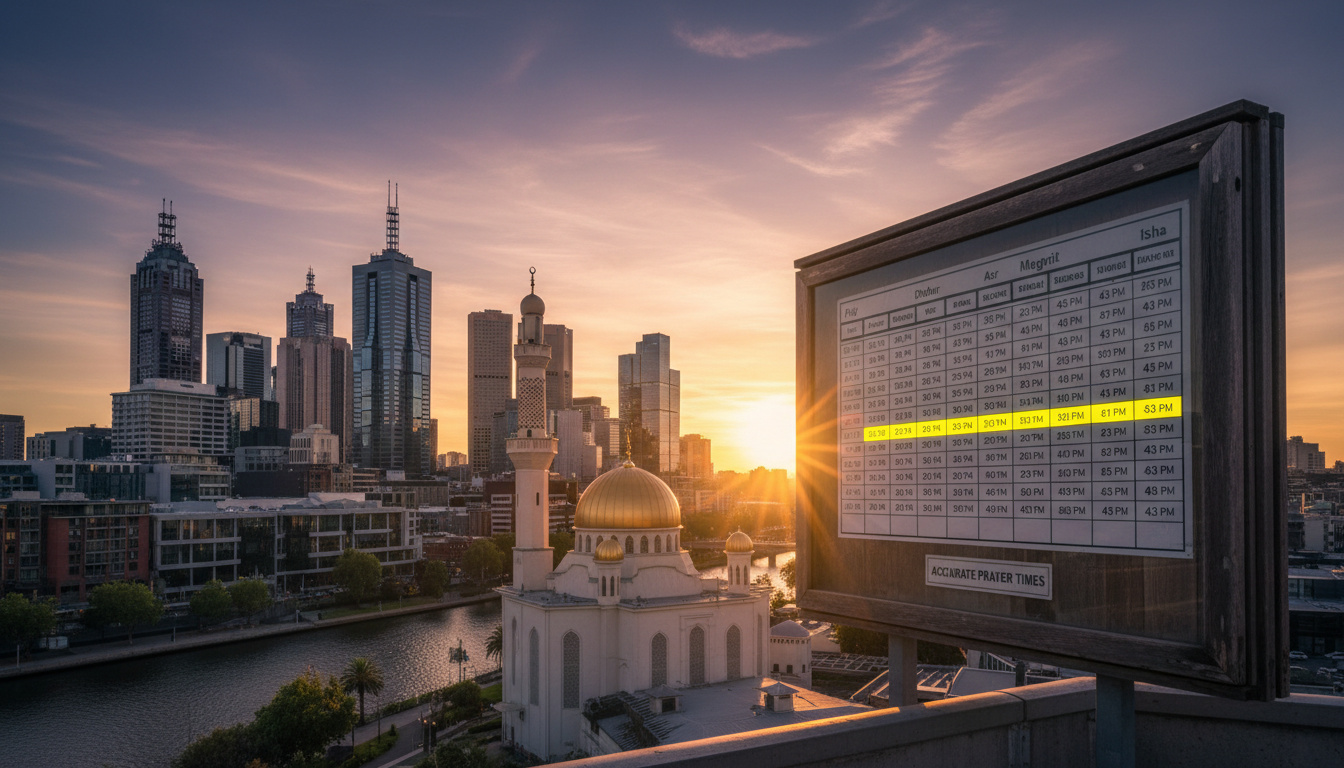

Muslims observing daily prayers in Melbourne face distinct timing variations for Asr, the afternoon prayer, due to the city’s southern latitude and differing jurisprudential calculations used by local mosques and digital platforms. Depending on whether an individual follows the Muslim World League (MWL) standard or the Hanafi school’s shadow length criteria, Asr on a typical April day can commence anywhere between 4:39 PM and 4:57 PM local time.
The variation stems from how Islamic jurisprudence interprets the sun’s position relative to shadow length, compounded by Melbourne’s location at approximately 37.8 degrees south. While global prayer time calculators provide standardized outputs, Australian congregations often adjust these times to accommodate local fiqh preferences and seasonal daylight shifts.
Understanding these nuances requires examining the specific data sources that Melbourne’s Islamic centers rely upon, from printed mosque schedules to digital platforms powered by PrayTimes.org algorithms.
What Time is Asr Prayer in Melbourne Today?
Current prayer schedules for Melbourne reflect the convergence of astronomical calculations and religious jurisprudence. On , representing a typical autumn day, the afternoon prayer window opens significantly later than in equatorial regions due to extended shadow lengths at this latitude.
Several factors create the variance seen across Melbourne’s prayer time resources:
- Melbourne’s latitude at 37.8°S extends shadow lengths significantly later than equatorial regions, pushing Asr toward late afternoon
- The Muslim World League (MWL) method typically yields the earliest Asr times at approximately 4:39 PM according to Hamariweb’s Melbourne schedule
- Hanafi calculations using double shadow length can delay Asr by 15 to 18 minutes compared to Shafi or Hanbali methodologies
- The Melbourne Grand Mosque posts Asr Adhan at 4:42 PM with Iqamah at 4:57 PM, reflecting local jurisprudential preferences
- The United Muslim Association lists Asr at 4:12 PM, demonstrating significant variation between congregations
- Digital platforms vary by 5 to 10 minutes depending on unadvertised twilight angle settings
- All times referenced use Australian Eastern Daylight Time (AEDT, UTC+11), requiring seasonal adjustment when daylight saving ends
| Prayer | Time (AEDT) | Calculation Method | Notes |
|---|---|---|---|
| Fajr | 6:09 AM | MWL (18° angle) | Pre-dawn beginning |
| Sunrise | ~7:05 AM | Standard astronomical | End of Fajr validity |
| Dhuhr | 1:23 PM | Solar zenith | Sun at highest point |
| Asr | 4:39-4:57 PM | Shadow length dependent | Varies by madhab |
| Maghrib | 7:10 PM | Sunset | Twilight begins |
| Isha | 8:32 PM | MWL (18° angle) | Night prayer |
What Are the Full Prayer Times in Melbourne?
Daily prayer schedules in Melbourne operate on five distinct periods that divide the day according to solar positioning. Unlike regions near the equator where prayer windows remain relatively stable year-round, Melbourne experiences significant seasonal shifts that affect every prayer time, particularly the afternoon and evening prayers.
Daily Schedule Structure
The complete cycle begins with Fajr at dawn and concludes with Isha after twilight darkness sets in. Muslim and Quran’s Melbourne data indicates Asr typically registers between 4:40 PM and 4:45 PM on their platform, while Salahtimes lists approximately 4:40 PM for the same prayer, illustrating the minor discrepancies between international aggregators.
Mosque-Specific Variations
Local congregations maintain autonomous schedules that may differ from global calculators. Some mosques prioritize community convenience by adjusting Iqamah times to allow congregants to arrive after the theoretical Adhan moment, while others adhere strictly to calculated astronomical moments.
Times listed on aggregator websites may differ from congregational prayer schedules by 10 to 15 minutes. The Melbourne Grand Mosque and United Muslim Association maintain independent timetables based on local fiqh council guidance rather than generic algorithmic outputs.
How is Asr Prayer Time Calculated for Melbourne?
The calculation of Asr depends on the length of an object’s shadow relative to its actual height, a measurement that varies significantly by geographic location and season. Turkish religious authority data for Melbourne confirms that southern hemisphere locations require specific algorithmic adjustments to prevent impractical timing during extreme seasonal variations.
Shadow Length Methodology
Islamic jurisprudence recognizes two primary standards for determining when Asr begins. The Shafi, Maliki, and Hanbali schools calculate the prayer time when an object’s shadow equals its height plus the length of the shadow cast at solar noon, known as the “one shadow” rule. Conversely, the Hanafi school waits until the shadow reaches twice the object’s height plus the noon shadow, effectively delaying the prayer window by roughly the time required for the sun to descend another 45 degrees.
Shafi and Hanbali jurisprudence define Asr beginning when an object’s shadow equals its height plus the noon shadow. Hanafi methodology waits until the shadow reaches twice the object’s height plus the noon shadow, typically resulting in a 15 to 20-minute delay at Melbourne’s latitude.
Latitude Adjustments for Southern Hemisphere
At Melbourne’s 37.8°S latitude, standard calculation methods remain applicable without requiring the extreme adjustments necessary for locations above 45° latitude. However, the southern hemisphere’s seasonal inversion means that April dates—placing Melbourne in early autumn—still feature relatively long daylight hours that extend afternoon shadows later than in equatorial regions. PrayTimes.org implementations used by Australian mosques incorporate these latitude considerations automatically.
While Melbourne sits below the 45° threshold requiring special summer adjustments, residents should note that Ramadan schedules show Asr shifting 30 minutes earlier as days shorten from summer toward winter, reflecting the dynamic nature of solar calculations at this latitude.
What is the Asr Prayer?
Asr represents the third of the five daily mandatory prayers in Islam, occurring in the afternoon when the sun has descended from its zenith but remains above the horizon. The prayer consists of four obligatory rak’ahs and serves as a spiritual midpoint between the noon prayer (Dhuhr) and the evening prayer (Maghrib).
The timing derives from Quranic references to the “late afternoon” prayer, with specific hadith detailing the Prophet Muhammad’s practice of performing the prayer when shadows had lengthened proportionally to objects. This connection to natural phenomena explains why calculation methods vary based on shadow length interpretations rather than fixed clock times.
In Melbourne’s mosque culture, Asr often marks a transition point in daily activity, with congregations varying in size depending on whether the time falls during standard working hours or closer to the evening commute. The variation in calculated times between 4:12 PM and 4:57 PM reflects these jurisprudential differences in interpreting the shadow length criterion.
How Do Prayer Times Progress Through the Day?
The Islamic daily cycle in Melbourne follows a precise astronomical sequence from dawn to night, with each prayer marking a distinct phase of solar movement.
- Fajr (6:09 AM): Dawn breaks, identified by the appearance of white light spreading horizontally across the horizon
- Sunrise (~7:05 AM): Solar disc becomes visible, marking the end of Fajr’s validity period
- Dhuhr (1:23 PM): Sun reaches its zenith; shadows point directly north in the southern hemisphere
- Asr (4:39-4:57 PM): Shadow length criteria met; calculation method determines specific minute
- Maghrib (7:10 PM): Sun sets below the horizon; fasting hours conclude during Ramadan
- Isha (8:32 PM): Twilight darkness fully descends; red afterglow disappears from western sky
Which Asr Times Are Definitive?
Established Information
- MWL method produces approximately 4:39 PM Asr for April 4, 2026
- PrayTimes.org algorithms power major Australian mosque scheduling websites
- AEDT (UTC+11) serves as the standard time zone reference for all Melbourne listings
- Melbourne Grand Mosque specifically lists 4:42 PM Adhan and 4:57 PM Iqamah
Information Remaining Unclear
- Exact offset between Adhan and Iqamah varies by mosque without standardized labeling
- Whether specific congregations use 1-shadow or 2-shadow calculation without explicit notation
- Exact twilight angle assumptions (12° vs 15° vs 18°) employed by every digital source
- Seasonal adjustment protocols for individual mosque prayer halls
Why Do Melbourne Prayer Times Vary by Source?
Melbourne’s position at 37.8°S latitude fundamentally alters shadow behavior compared to Middle Eastern or Southeast Asian locations where many calculation standards originated. The city’s longitude at 144.9631° east places it within a time zone that experiences extended summer daylight, necessitating careful algorithmic handling of the twilight periods that define Fajr and Isha.
Local mosques increasingly rely on Pounds to AUD – Today’s Rate, History and Forecast for administrative planning related to international donations and facility maintenance, though prayer calculations remain strictly astronomical.
The convergence of Hanafi-majority immigrant populations with Shafi and Hanbali methodological standards creates the variance observed between the United Muslim Association’s earlier times and the Melbourne Grand Mosque’s later schedule. Without federal standardization of religious calculation methods, these differences persist as legitimate jurisprudential variations rather than errors.
Where Do Melbourne’s Prayer Data Originate?
Primary sources for Melbourne prayer schedules include direct mosque publications, international Islamic authorities, and open-source calculation libraries adapted for Australian coordinates.
Asr time is calculated when an object’s shadow length equals its height plus the noon shadow. Variations between 1 shadow and 2 shadows methodologies explain the 15 to 18-minute differences observed across Melbourne sources.
— PrayTimes.org Documentation via Australian Mosque Implementations
Melbourne Grand Mosque utilizes specific local adjustments to global calculation standards, resulting in Adhan at 4:42 PM and congregation prayer at 4:57 PM for April 2026 dates.
— Melbourne Grand Mosque Schedule Data
Key Takeaways on Asr Prayer Times in Melbourne
Asr prayer in Melbourne requires attention to methodological differences that can shift the prayer window by nearly twenty minutes depending on whether one follows the Muslim World League standard or Hanafi calculations. Local mosques maintain independent schedules that prioritize community congregation over strict astronomical precision, while digital platforms offer approximate times based on global algorithms. For those managing Best Savings Accounts Australia – Top Rates Compared alongside religious observances, verifying times directly with local congregations ensures accuracy.
Frequently Asked Questions
What time is Asr now in Melbourne?
Current Asr times vary by calculation method, typically ranging from 4:39 PM to 4:57 PM AEDT depending on whether your source uses Muslim World League or Hanafi shadow length standards.
Why do different websites show different Asr times?
Variations arise from methodological differences in shadow length calculation (one shadow versus two shadows) and twilight angle assumptions for Fajr and Isha prayers.
Which calculation method do Melbourne mosques use?
The Melbourne Grand Mosque utilizes PrayTimes.org with specific local adjustments, while other congregations like the United Muslim Association may follow different fiqh council guidelines.
Does Asr time change throughout the year?
Yes, Asr shifts approximately 30 minutes earlier as days shorten from summer toward winter, reflecting the changing solar position at Melbourne’s latitude.
What is the difference between Adhan and Iqamah?
Adhan marks the theoretical start time when calculation criteria are met, while Iqamah indicates the actual congregation time, typically occurring 10 to 15 minutes later at Melbourne mosques.
How does latitude affect prayer times in Melbourne?
Melbourne’s 37.8°S latitude extends shadow lengths later in the afternoon compared to equatorial regions, pushing Asr times toward 4:40 PM rather than mid-afternoon.
Are prayer times different in other Australian cities?
Yes, cities at different latitudes such as Sydney, Brisbane, and Perth experience significantly different prayer time patterns due to their distinct solar positions and daylight durations.
Related stories



Liam O'Brien covers Australian politics and public affairs for Coast Current.