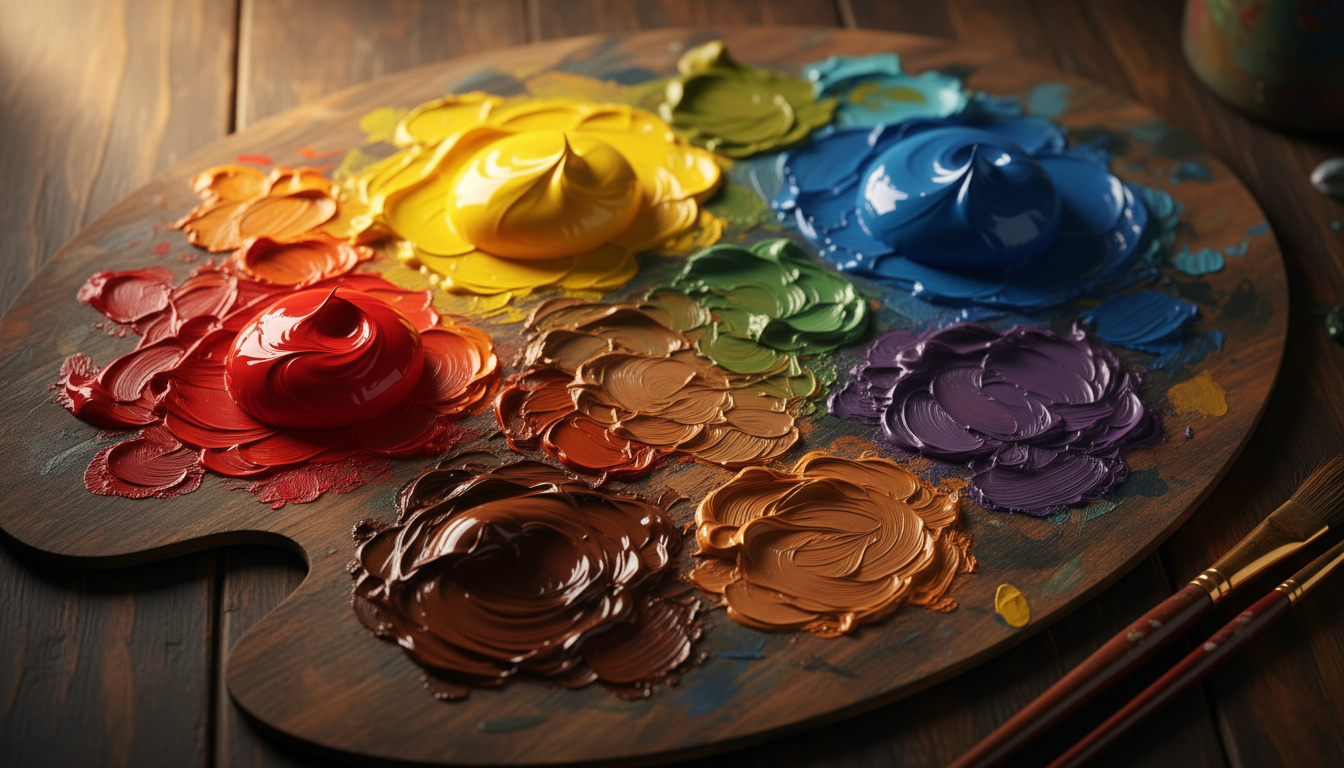
Brown remains one of the most versatile neutral colours in art and design, yet creating it from scratch often confuses beginners. Unlike primary colours that stand alone, brown emerges from the careful balancing of multiple pigments that absorb and reflect specific wavelengths of light.
Understanding how to mix brown requires grasping subtractive colour theory—the same principle that governs Dark and Stormy Cocktail hues in beverage photography or the warm tones in food styling. Whether working with watercolour, acrylic, or digital media, the fundamental approaches differ significantly from simply combining random paints.
What Primary Colours Make Brown?
Traditional pigment mixing relies on the RYB (Red, Yellow, Blue) model. Drawing tutorials confirm that when these three primaries combine in unequal ratios, they create brown through desaturation, provided the proportions remain imbalanced to avoid neutral black.
The classic primary trio creating neutral browns
Complementary pair for rapid mixing
Opposite colours containing all primaries
Secondary complement for warm earth tones
- Avoid equal ratios to prevent muddy black results
- Pigment strength varies significantly between brands
- Always test mixtures on scrap paper before application
- Warm primaries produce richer, earthier browns
- Cool primaries yield ashy, neutral browns
- Start with red and blue to form a purple base
- Add yellow incrementally to control warmth
| Method | Colours Used | Ratio Guidance | Result |
|---|---|---|---|
| Traditional Primaries | Red, Yellow, Blue | 1:1:1 (adjust to taste) | General purpose brown |
| Complementary Orange | Orange, Blue | 2 parts orange to 1 blue | Rich earth tone |
| Complementary Purple | Purple, Yellow | 1:1 to 1:2 | Warm light brown |
| Complementary Green | Red, Green | 1:1 with desaturated green | Olive brown |
| Red-Black Shortcut | Red, Black | 3:1 | Burnt sienna-like |
| Printing Primaries | Cyan, Magenta, Yellow | 2:1:2 | Process brown |
What Two Colours Make Brown?
Complementary colours—those positioned opposite each other on the colour wheel—provide the quickest route to brown. Art instructors explain that these pairs effectively contain all three primaries when combined, cancelling out saturation to leave a neutral brown.
Orange and Blue Combinations
Orange already contains red and yellow pigment. Adding blue introduces the missing primary, creating instant brown. Video demonstrations show that darkening orange slightly with blue produces neutral browns particularly suited for sky and sunset transitions.
Purple and Yellow Mixes
Purple combines red and blue; adding yellow completes the primary set. Colour theory resources recommend increasing yellow proportions for lighter, golden browns reminiscent of historical royal robes paired with gold.
Red and Green Pairings
Green brings yellow and blue to the mixture; red provides the final component. However, technical guides caution that saturated greens risk creating black unless desaturated versions are used.
When using complementary pairs, test on scrap paper first. Pigment strength varies dramatically—phthalo blue overpowers quickly, while ultramarine requires more generous application.
What Colours Make Dark Brown?
Achieving deep, rich browns without resorting to black requires strategic bias toward cool tones. Dark browns emerge when blue or purple dominates the mixture, absorbing more light wavelengths than warm counterparts.
Without Using Black
Dark chocolate browns result from mixing red and blue first to create a purple base, then introducing minimal yellow. Painting tutorials confirm that no black is necessary when sufficient cool primaries are present.
High-quality dark browns rely on blue pigment concentration rather than black addition. This preserves colour vibrancy and prevents the deadened quality that mars mixed blacks.
Adjusting Primary Ratios
Increasing the blue component relative to yellow shifts the temperature cooler while deepening the value. Conversely, maintaining yellow dominance while adding small amounts of blue creates lighter tans and fawns.
How to Make Brown in Different Mediums?
The physical properties of different artistic mediums fundamentally alter how brown appears. Pigment behaviour in watercolour differs radically from digital RGB approximations.
Watercolour and Acrylic Techniques
In transparent watercolour, brown mixes remain luminous because light reflects off the paper through the pigment layers. Watercolour guides suggest starting with permanent pigments like pyrrole red, cadmium yellow, and ultramarine for predictable results.
Digital RGB Values
Screens use additive colour mixing—red plus green plus blue creates white, not brown. Digital browns approximate the colour by lowering brightness and saturation simultaneously. A typical medium brown registers approximately RGB (101,67,39), though no pure mixing formula exists without desaturation tools.
CMYK for Printing
Commercial printing employs cyan, magenta, yellow, and black inks. Printing tutorials note that process browns require careful balance of all three colours plus minimal black to avoid muddy results.
RGB screens emit light, making brown an absence of pure primaries rather than a mixture. Never apply physical paint ratios to digital colour pickers—the physics differ completely.
How Has Brown Mixing Evolved?
The understanding of brown as a mixed colour rather than an earth pigment developed alongside colour theory itself.
- : Isaac Newton’s colour wheel establishes complementary relationships, though brown remains classified as a low-saturation colour.
- : Artists rely exclusively on raw umber and burnt sienna earth pigments rather than mixing browns from primaries.
- : Synthetic pigments like alizarin crimson and cobalt blue make reliable brown mixing possible for the first time.
- : Printing industry adopts CMYK process colours, standardising brown mixtures for mass reproduction.
- : Digital art software introduces RGB sliders, requiring artists to learn additive colour principles for screen-based work.
- : Modern lightfast pigments allow archival brown mixing that resists fading previously associated with organic earth colours.
What Is Certain About Mixing Brown?
While empirical testing remains essential, certain principles hold consistently across mediums.
| Established Facts | Uncertain Variables |
|---|---|
| Brown requires all three primaries or complementary equivalents | Exact universal ratios due to pigment chemical variations |
| Equal ratios of primaries create black or grey, not brown | Specific brand formulations affecting mixing strength |
| Subtractive mixing (pigments) differs fundamentally from additive (light) | “Perfect” brown definition across cultural contexts |
| Cool tones deepen brown; warm tones lighten it | Long-term lightfastness of mixed vs single-pigment browns |
Why Do These Colours Make Brown?
Brown emerges from the physics of subtractive colour mixing. When pigments combine, each absorbs specific wavelengths of light. Red absorbs greens, blue absorbs yellows and oranges, while yellow absorbs blues and violets. Technical explanations describe how overlapping absorption spectra leave only the middle wavelengths—perceived as brown.
This phenomenon explains why digital screens cannot “mix” brown through simple addition. RGB pixels emit light rather than absorbing it; adding red, green and blue emissions creates white. Digital brown simulates the colour by reducing overall luminosity while maintaining unequal channel values, mimicking the absorption patterns of physical pigments.
Understanding this distinction helps artists troubleshoot why their How to Fix Slow Cooker Recipes for brown paint succeeds on canvas but fails when photographed under specific lighting conditions.
What Do Colour Experts Recommend?
Professional artists and colour theorists emphasise practical testing over rigid formulas.
Start with red and blue to make a purple, then gradually add yellow until you reach the desired brown. The specific pigments—whether cadmium or pyrrole—dramatically alter the final temperature.
— Drawing Tutorials Analysis
Avoid equal ratios to prevent black; test on scrap paper as pigment strength varies. Warm and cool versions of primaries significantly broaden your brown range.
— Virtual Instructor Colour Theory
What Is the Simplest Way to Make Brown?
Mix red, yellow, and blue in unequal proportions—starting with a purple base and adding yellow incrementally provides the most control. For faster results, combine orange and blue or purple and yellow in complementary pairs. Remember that Dark and Stormy Cocktail presentations and food photography often rely on these exact principles to achieve warm, appetising earth tones without synthetic brown pigments.
Common Questions About Mixing Brown
What colours make brown without black?
Combine red, yellow, and blue primaries, or mix complementary pairs like orange-blue or purple-yellow. Dark browns emerge from higher blue content without needing black pigment.
What RGB values make brown?
Approximate brown using RGB values around (101,67,39) for medium tones, though digital brown requires desaturation and brightness reduction rather than simple channel mixing.
How to make brown in watercolour?
Start with transparent washes of red and blue to create purple, then glaze yellow over the top. The white paper shining through maintains luminosity impossible with opaque mediums.
Can you make brown with just two colors?
Yes, mixing complementary colours—orange/blue, purple/yellow, or red/green—creates brown because each pair contains all three primaries between them.
Why does mixing equal parts make black?
Equal ratios of red, yellow, and blue absorb all visible light wavelengths equally, leaving no reflected colour—perceived as black or dark grey rather than brown.
What two colours make brown easily?
Orange and blue provide the simplest two-colour mixture, as orange already contains red and yellow, requiring only the addition of blue to complete the primary set.
Related stories



Chris Hayes covers culture, lifestyle and society across Australia for Coast Current.